
The Page Raised a Question. You Do Not Have to Close It Tonight.
Use a reading notebook to preserve a precise unresolved question, separate an author’s claim from your response, and return with evidence rather than forced certainty.

IN THIS ARTICLE
A question can survive the closed bookRecord the claim before recording your reactionMake the uncertainty small enough to investigateGive different kinds of questions different treatmentLet an example expose the missing distinctionResist making uncertainty another performanceReturn when the question has somewhere to goLet some questions remain part of your lifeA question can survive the closed book
You finish a chapter and feel that something important remains unsettled. Perhaps the author's account of freedom conflicts with an experience you cannot easily explain. You could search for a ready-made answer, dismiss the chapter or stay awake trying to force a conclusion. Another option is to preserve the question clearly enough that you can return to it. A reading notebook can hold an unfinished inquiry without becoming a list of tasks you owe yourself. The CyGuru question is about your relationship to uncertainty: can you remain the person examining an idea when the idea has not yet become a position you can announce? Closing the book for the night does not require either agreement or rejection. It can mark the beginning of a more precise encounter with the subject.
Record the claim before recording your reaction
Write a short account in your own words of what you think the author is claiming, with the page or section that lets you find it again. Keep that account separate from your response. You may have been moved by the language, annoyed by the confidence or reminded of a painful experience; those reactions matter as part of your reading, but they are not automatically the claim itself. A notebook entry that says only that a chapter was powerful may preserve the feeling while losing the question. Try instead to state the proposition and where your uncertainty begins. If you cannot yet summarize it fairly, note that difficulty. Returning to understand the argument is a different task from finding evidence that confirms the response you had while encountering its tone.
Make the uncertainty small enough to investigate
A vague entry such as what is the meaning of life can be sincere and still provide little direction for the next reading. A narrower question might ask whether the author treats responsibility as a personal choice, a social obligation or both. You can then identify which passages support each interpretation. Precision does not make a serious question small in importance. It gives you a place to begin. University reading guidance from UNSW recommends questioning material and noting further questions; it also distinguishes personal reflection as a learning tool from evidence that proves or refutes a finding. This is educational guidance, not a study establishing that every notebook improves every reader's life. Its relevance here is practical: record the next thing you need to understand, rather than demanding an answer to everything at once.
Give different kinds of questions different treatment
Some uncertainties concern what a sentence means. Others concern whether a factual assertion is supported, whether an argument follows, or what you want to do with an idea in your own life. These questions can appear on the same page but require different work. A definition may resolve a meaning question. A primary source may help assess a factual claim. Neither automatically tells you which personal commitment to make. Mark the type of question in ordinary language if that helps: I do not understand the term, I need to check the evidence, or I am unsure how this fits my values. The distinction prevents you from treating a moving personal interpretation as scientific confirmation or asking an empirical study to settle every question about the purpose you give your life.
Let an example expose the missing distinction
Imagine reading that independence means needing nobody. You feel both attraction and discomfort because you value autonomy while caring deeply about family and friendship. Instead of accepting the statement as a command, record the distinction you want to examine: does independence mean making your own decisions, or avoiding all reliance on others? Note an ordinary example, such as choosing whether to accept practical help during a move. You can then return to the book and see whether the author actually makes the stronger claim or whether your reaction expanded it. The notebook has done something useful even without a final answer. It has turned an impression into a question you can test against the text, your experience and other accounts without pretending those forms of inquiry are interchangeable.
Resist making uncertainty another performance
A beautiful notebook can become a place where you demonstrate sophistication to an imagined reader. You copy impressive phrases, build elaborate categories and leave little room for the plain sentence that would reveal what you do not understand. In CyGuru psychology, the useful question is whether the activity serves understanding or the protection of an identity as someone who already understands. The nervous-system doctrine is used here as an interpretive framework for that response; it does not establish a diagnosis or a proven cognitive mechanism behind your handwriting habits. An honest entry can be awkward and unfinished. It may be only a question, a page number and a possible next source. Its value lies in allowing you to return to the inquiry without having to reconstruct an impressive version of the person who first wrote it.
Return when the question has somewhere to go
You do not need to review every entry on a rigid schedule. Return when another chapter, conversation or source makes the question relevant, or when you deliberately choose time for it. Oregon State University's reading guidance suggests monitoring comprehension through questions and noting issues for further exploration. Adapt the practical idea to your purpose rather than turning leisure reading into an examination. On returning, write what changed: perhaps you found a definition, noticed a counterexample or realized that the original question was based on a misunderstanding. Preserve the earlier entry when it helps you see that change. You are not obliged to defend your first formulation. A notebook can show inquiry developing instead of becoming a monument to the first confident thought you happened to record.
Let some questions remain part of your life
An unresolved question is not always a neglected duty. Some questions accompany different seasons of a life and receive better formulations rather than permanent solutions. Others become irrelevant, and you may choose to stop pursuing them. The distinction is yours to examine: are you leaving the question because it no longer serves your inquiry, or because uncertainty feels embarrassing? You need not answer that immediately either. The Human Codes reading places value in an active relationship with ideas, where attention can remain honest about its limits. At the end of tonight's chapter, you can write what you understand, preserve what you do not and go back to the rest of your evening. The open page in the notebook can hold a question without requiring the whole of your life to remain on hold beside it.
Continue the reading path
- The Last Teacher: What would it mean to learn from someone without surrendering your judgment?
- The Life Code of CYGURU: Which principle would change a decision you are making this week?
Sources and further reading
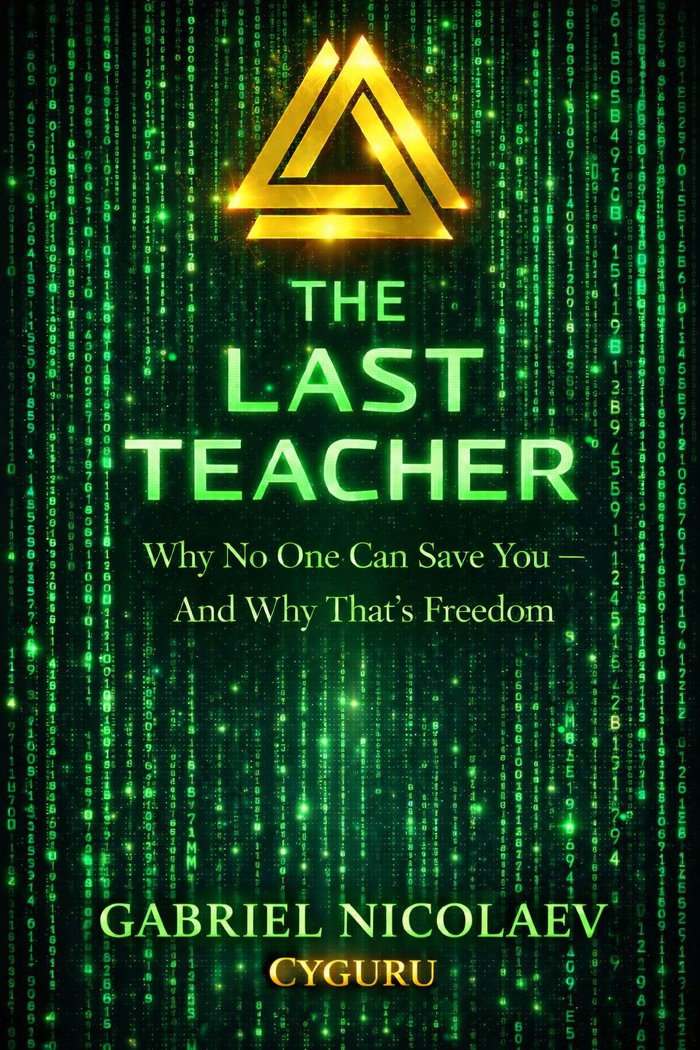
The Last Teacher
A teacher can become most significant when the learner begins to examine how authority has shaped their questions. This title invites a reflective reading of guidance, independence and the point at which borrowed answers must be reconsidered.
View & order on CYGURU.com ↗