
The Anunnaki: Ancient Sources, Modern Interpretations and Power
Read the Anunnaki through Mesopotamian religious sources, the modern extraterrestrial interpretation and the ethical question of knowledge that creates dependence.
IN THIS ARTICLE
Begin with the ancient name before adding a modern explanationA written source needs a setting, not only a striking sentenceWriting also records ordinary human institutionsThe architect narrative changes the meaning of a giftA sky reference does not automatically describe a spacecraftFollow the interpretation through its transmissionAncient achievement does not need to be minimizedThe story can illuminate a present-day responsibilityKeep the layers visible as you readBegin with the ancient name before adding a modern explanation
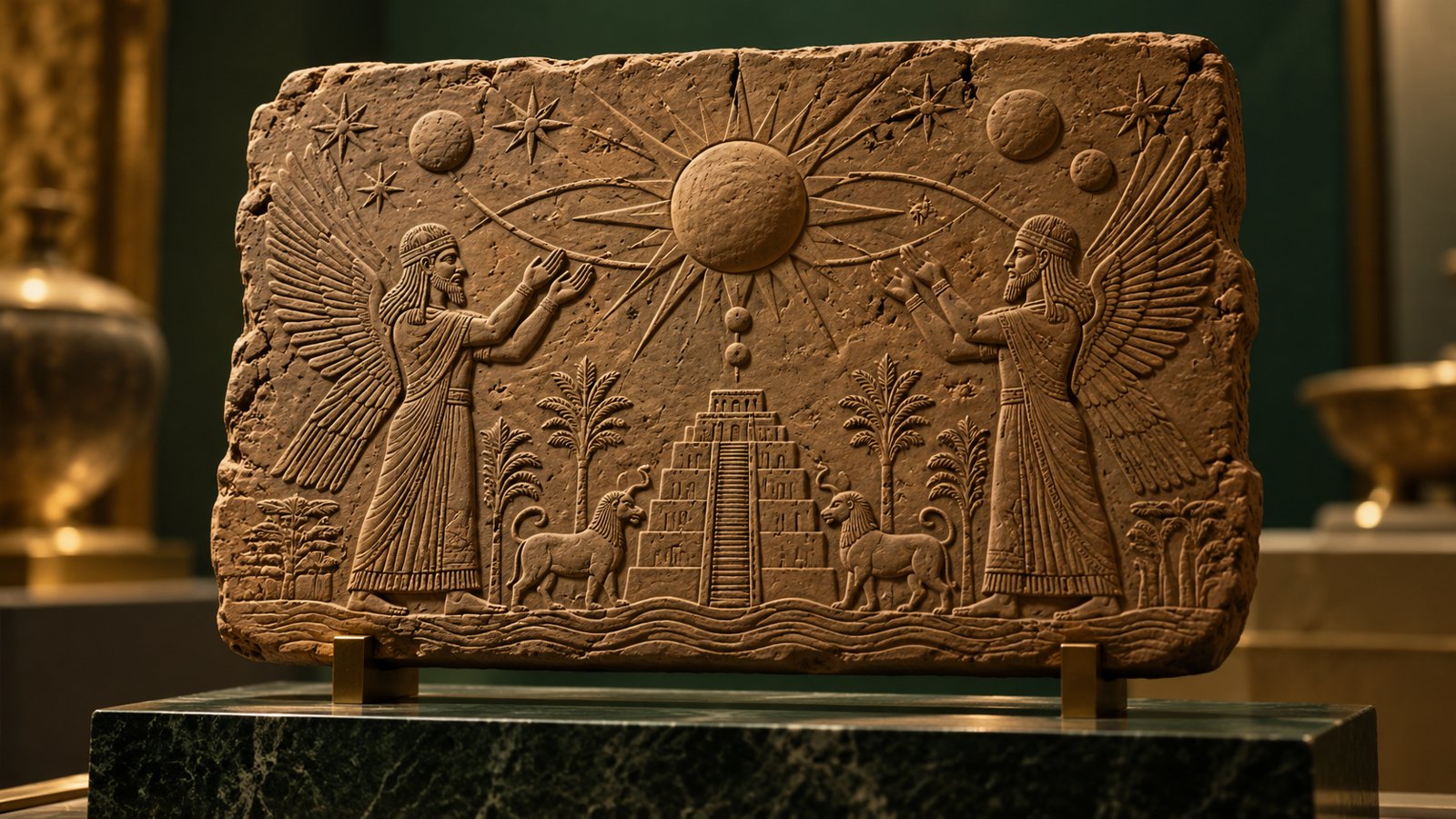
The Anunnaki occupy a distinctive place in contemporary stories about humanity’s origins. They are often presented as visitors, teachers or architects whose knowledge transformed civilization. Before evaluating that interpretation, the reader needs a simpler distinction: the name belongs to ancient Mesopotamian religious material, while an account of extraterrestrial intervention is a further claim. The presence of an ancient name does not independently establish the modern explanation attached to it.
The ORACC scholarly resource identifies Anunna, also rendered through related forms such as Anunnaki, as a group of gods within the Mesopotamian pantheon. That is the historical starting point. It leaves substantial room for studying religion, literature and the organization of meaning in ancient societies. It does not turn a divine figure into a documented biological visitor or make a modern technological reading the only serious way to engage with what the texts meant to the people who produced them.
A written source needs a setting, not only a striking sentence
Ancient texts survive through particular objects, languages, copies and acts of interpretation. A passage should be located within that context before it is treated as a technical report. Ask which text is being discussed, where the translation comes from and what kind of writing it is. A religious narrative, an administrative record and a modern paraphrase do not have identical purposes or support the same conclusions simply because all can be printed as words on a page.
A quotation described only as an ancient tablet is difficult to assess. The reader needs enough information to distinguish the source from the commentary. A responsible account makes that path available. It should be possible to discover which claim belongs to the ancient material and which was supplied by an interpreter. Without that separation, the authority of antiquity can be transferred to a modern sentence that the original source may never have said or implied in the form now being repeated.
Writing also records ordinary human institutions
Museum collections preserve Mesopotamian administrative tablets alongside religious material. The Metropolitan Museum of Art, for example, describes cuneiform records connected with distributions and accounting. These objects help situate writing within the activity of cities, transactions and organized institutions. They are a reminder that ancient societies were composed of people carrying out practical work, not merely a background onto which later readers can project a mystery whose only proposed explanation is outside intervention.
This does not make every question about ancient development settled. It gives inquiry a material basis. Before claiming that a capability appeared without human precedent, investigate the evidence for how people recorded, transmitted and adapted knowledge. A spectacular reconstruction can ignore the ordinary traces that make a more complex historical account possible. Curiosity becomes more demanding when it includes those traces rather than treating the absence of familiarity with them as proof that no human explanation exists.
The architect narrative changes the meaning of a gift
Within The Alien Codex’s speculative framework, the Anunnaki represent an outside intelligence associated with order, knowledge and hierarchy. That narrative can be examined philosophically without presenting it as established archaeology. A teacher who supplies valuable knowledge may also determine which questions are allowed, who receives access and what obligations follow. The gift of a system does not automatically settle whether the people using it have gained autonomy or become dependent on an authority they cannot evaluate.
Consider a fictional city whose essential tools are understood only by its founders. The inhabitants benefit, but cannot revise the rules without risking the service. Is the arrangement education or managed dependence? The answer concerns ownership of knowledge, not merely its sophistication. This is a powerful use of the architect image: it makes progress ethically complicated. Its value does not require claiming that a particular human institution was physically designed by extraterrestrials who left a verified record of their intervention.
A sky reference does not automatically describe a spacecraft
Religious and literary language can locate authority above the ordinary world. A modern reader may find a technological analogy compelling, but the analogy is not itself a translation. Ask what the word or image meant within its own setting and what evidence justifies choosing one interpretation over others. A familiar machine can make an ancient passage easier to imagine while quietly inserting details that the source does not actually supply.
The same caution applies to claims about genetic design. A story about the making of humanity is not equivalent to molecular evidence of engineering. The empirical claim would require independent biological support and a method capable of distinguishing the proposed intervention from alternatives. The narrative and the scientific question can both be interesting. Treating them as interchangeable removes the very evidence requirements that would allow an extraordinary historical claim to become more than an imaginative possibility.
Follow the interpretation through its transmission
A claim can appear in many books or videos while depending on one modern account. Repetition is not the same thing as independent confirmation. Trace the reference backward. Does each writer cite a text, or do they cite another commentator who eventually leads to the same unsupported assertion? A long chain of confident retelling can create the appearance of a large evidentiary base while adding no new material to the original claim.
Look also for changes in certainty. One account may propose an analogy, another repeat it as likely history and a third describe it as an ancient fact suppressed by conventional scholarship. The transformation matters. A responsible reader should not have to choose between accepting the final version and dismissing every question about antiquity. You can retain interest while returning the statement to its original level of support and asking what additional evidence would be needed before the confidence could reasonably increase.
Ancient achievement does not need to be minimized
The suggestion that construction, agriculture or administration must have exceeded human capability deserves evidence. Otherwise a story intended to expand humanity’s origins can erase the ingenuity of the people whose work actually survives. Respect for ancient knowledge begins by studying what those societies did, the constraints they faced and the evidence they left. It does not require making them passive recipients of skills that a modern observer has not taken time to understand.
An unresolved problem remains a problem to investigate. It is not a blank space that one preferred explanation automatically owns. The same standard should apply whether the proposal is conventional, unusual or emotionally appealing. What supports the account? What does it leave unexplained? Which observation could distinguish it from a competing view? These questions preserve openness while preventing the mystery itself from doing the evidentiary work that a claim about external visitors still needs to perform.
The story can illuminate a present-day responsibility
The Anunnaki narrative is especially useful as a question about the relationship between knowledge and power. Who controls an indispensable system? Can those affected understand it, question its rules or change their participation? These are current human questions that do not depend on accepting a cosmic origin. A reader can use the story to notice a pattern in an institution without assigning an extraterrestrial identity to its members or claiming a secret continuity unsupported by the records.
Bring the discussion to an observable arrangement. A technology provider, an employer or a public institution can be evaluated through actual decisions and consequences. The metaphor may sharpen attention, but it should not replace evidence about the case. The strongest application makes the practical inquiry more precise. The weakest turns every example of dependence into proof that the same hidden architect must be directing all of history from outside human view.
Keep the layers visible as you read
The Alien Codex and CySociety connect the themes of origins, guidance and the design of collective life. Read the Anunnaki material in three layers: ancient religious sources, modern extraterrestrial interpretation and the philosophical problem the story raises. Each deserves a different standard. A translation needs linguistic and historical context; a visitation claim needs independent evidence; an ethical scenario can be explored through the clarity and consequences of the question it asks.
The hidden history is most worth investigating when the word hidden means a question we have not yet understood, not permission to declare every preferred answer established. Ancient Mesopotamia offers a rich record of human thought and organization. Speculation can open another imaginative space beside it. Keeping those spaces distinct allows the reader to appreciate both without making a modern cosmic narrative the unexamined owner of the people, texts and achievements that actually belong to the historical record.
Continue the reading path
- THE ALIEN CODEX: What looks obvious only because you have never observed it from outside your usual frame?
- CySociety: What behavior does a social arrangement reward even when it claims to oppose it?