
Civilian War Preparation: Preserve Your Household’s Options
Prepare for conflict through household planning, verified information, essential supplies, medical continuity and decisions that preserve civilian options.
IN THIS ARTICLE
Civilian survival begins with usable optionsCalm is a tool, never a guaranteeMap the household before buying suppliesKeep information separate from its emotional packagingPrepare shelter and movement as different plansProtect identity, care and communicationPreserve financial access without gambling on the crisisBuild cooperation that survives a difficult dayTurn the plan into a short, repeatable reviewCivilian survival begins with usable options
War can remove ordinary choices with frightening speed. A pharmacy closes, a road becomes unsafe, a payment system stops working, and a familiar neighbourhood no longer offers the protection it did yesterday. Preparation means identifying those dependencies while there is still time to reduce them. It does not mean believing that a person can control a conflict through determination. Violence, displacement and infrastructure failure can overwhelm even careful households. The purpose of planning is to improve the choices available under those conditions.
The central argument of How to Survive War becomes practical when stability is translated into tasks. Who needs assistance? Where are the documents? Which information sources can be checked? What would require sheltering, and what would justify departure? These questions are less dramatic than survival imagery, but they expose the work that actually protects a family. A useful plan makes the next necessary action easier to recognise and perform.
Calm is a tool, never a guarantee
Fear is an understandable response to danger. It can increase attention and prompt protective action. It can also make complicated decisions harder when exhaustion, alarming messages and conflicting responsibilities accumulate. The objective is not to eliminate fear or judge people for experiencing it. It is to reduce avoidable overload so that essential decisions remain possible. Someone who freezes or becomes distressed needs support, not a lecture about weakness.
If immediate safety allows, use a brief pause to identify the problem in concrete terms: the instruction received, the person missing, the medicine running low. Speak one task at a time. A trusted companion can repeat information or handle a phone call while another person packs. Rest, food, hydration and simple routines support functioning when available. These measures complement physical protection and professional assistance; they cannot make an unsafe building, road or military situation safe.
Map the household before buying supplies
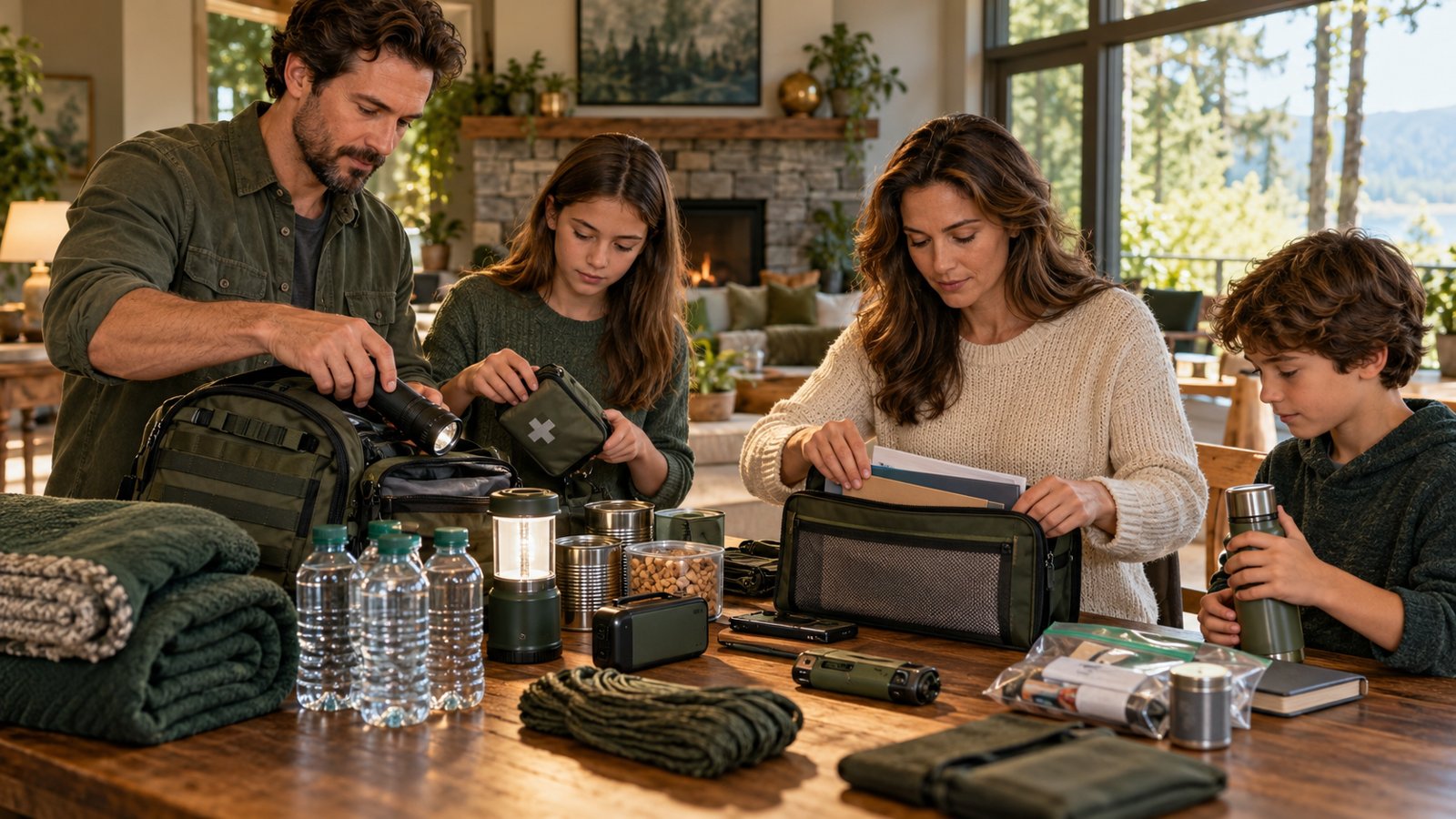
A generic emergency bag can overlook the person who matters most. An older relative may need mobility assistance. A child may need a familiar object and clearly written contact details. Someone using insulin, oxygen or another essential treatment needs a continuity plan developed with appropriate clinicians or suppliers while services are functioning. A household is prepared only when the plan accounts for its actual members.
Write an inventory of recurring needs and the systems supporting them. Include water, food preparation, sanitation, electricity, communication, transport, medication and caregiving. Then ask what happens if each fails for a period relevant to local emergency guidance. Where safe and affordable, create reasonable reserves, rotate perishable items and keep equipment accessible. Avoid buying more than can be stored, carried or used. A collection of supplies without a clear purpose can consume money while leaving the most consequential dependency unresolved.
Keep information separate from its emotional packaging
A message can feel urgent without being accurate. Before changing a plan, identify who issued the information, when it was issued, which location it concerns and whether a competent local authority or established humanitarian organisation confirms it. A video reposted today may show an older event elsewhere. A confident neighbour may be repeating an unverified story. Repetition across accounts does not necessarily mean independent confirmation.
Choose a small set of relevant channels rather than trying to absorb every update. Include official emergency instructions, local civil protection where available, and recognised humanitarian services appropriate to the area. Preserve battery power and keep essential numbers offline. If networks are unreliable, agree in advance how and when household members will check in. Avoid publishing live locations, movement plans or identifying details that could expose other civilians. Information should support a decision, not merely intensify the atmosphere around it.
Prepare shelter and movement as different plans
Staying and leaving each have risks. A household should consider both before an emergency, following competent local guidance for its circumstances. Identify the designated shelter or safer location, accessibility constraints and essentials needed there. Separately, identify possible destinations, transport arrangements, documents and assistance required if an evacuation is advised or becomes necessary. A destination is more than a place on a map: it must have a credible way to receive the people travelling.
Do not treat an old route, an online shortcut or an announced corridor as a standing guarantee of safety. Conditions can change, and local instructions matter. During immediate danger, prioritise current protective directions over completing a checklist or collecting possessions. Avoid approaching damaged military objects, debris or unfamiliar devices. The ICRC documents the continuing threat from mines and explosive remnants. Do not touch or move suspected ordnance; withdraw without approaching it and seek guidance from competent local services when safely possible.
Protect identity, care and communication
Documents often become essential precisely when replacing them becomes difficult. Keep accessible identification, relevant residence or travel permissions, medical summaries, prescriptions and contact details. Secure copies can help, but do not assume that a photograph of a document substitutes for an original at a border or official procedure. Check the requirements relevant to the journey rather than relying on someone else's experience.
Keep sensitive material protected. An unlocked phone containing every password and identity record creates another vulnerability. Arrange access for a trusted person where appropriate without broadcasting private data. For children and dependent adults, establish an age-appropriate reunification plan and identify who is authorised to collect or accompany them. Do not separate a child from a caregiver merely because an unfamiliar person promises faster transport. Recognised family tracing and protection services can be important when separation occurs; improvising through public social media can expose vulnerable people further.
Preserve financial access without gambling on the crisis
Conflict can interrupt earnings and access to money. The practical financial objective is continuity: paying for necessities, maintaining records and avoiding dependence on a single fragile payment method where alternatives are lawful and feasible. Modest accessible funds, protected account information and an understanding of essential obligations can be more valuable than elaborate speculation. Local restrictions, currency rules and personal circumstances must guide the details.
Be cautious when urgency becomes a sales technique. Offers of guaranteed transport, privileged access, emergency investment returns or unusually favourable currency conversion may exploit fear. Verify the provider independently and understand what a payment actually secures. Do not risk rent, medication or relocation funds because a commentator describes a crisis as a market opportunity. Reconstruction may create economic activity later, but that observation does not turn a household emergency reserve into investment capital. Liquidity has a purpose before it has a return.
Build cooperation that survives a difficult day
A small support network can share information, transport and caregiving. Its value depends on realistic commitments. Instead of asking whether someone will help in general, agree who can check on a neighbour, carry a particular bag or contact a relative if communications fail. Include a backup because the first helper may also need assistance. Do not assume that one capable person can coordinate everybody indefinitely.
Disagreement becomes easier to manage when decision rules exist before pressure rises. Discuss what information would trigger reconsideration of shelter, movement or spending. Give children simple explanations without making them responsible for adult decisions. Protect periods of rest when conditions permit. Asking for help early can preserve capacity for the next day. Humanitarian protection is a collective responsibility; survival should never be presented as a character test in which people harmed by violence somehow failed to remain sufficiently disciplined.
Turn the plan into a short, repeatable review
A plan becomes useful through rehearsal and revision. Can the necessary bag be found without searching? Does the emergency contact still answer? Can the person with limited mobility reach the agreed location? Are medicines in date and charging arrangements workable? Test small practical steps while conditions are calm enough to do so. Correct a discovered weakness without treating it as evidence that the entire household has failed.
Use How to Survive War as a framework for discussing preparedness, and use current local emergency instructions for immediate protective action. This article offers general civilian planning, not a route assessment or tactical guarantee. Its deepest principle is continuity under pressure: preserve the ability to identify needs, ask for support and revise a decision when facts change. A prepared person does not know everything that will happen. They have reduced the number of essential decisions that must be invented at the worst possible moment.
Continue the reading path
- HOW TO SURVIVE WAR: Which essential decision could you prepare before it becomes urgent?
- WAR AGAINST CHAOS: Which repeated problem could be reduced by one clear rule or boundary?