
You Cannot Keep the Whole Life in Every Object.
Choose what to preserve after a loved one dies without treating belongings as a test of loyalty or imposing a timetable on grief.
IN THIS ARTICLE
The cupboard contains more than thingsBegin with the decisions that are actually yoursA pause is different from an obligation to preserve everythingAsk what the particular object helps you rememberThe siblings may be remembering different homesDo not turn keeping into a duty to stop livingCare may require support beyond the sorting taskLet remembrance have more than one place to liveThe cupboard contains more than things
A year after your mother dies, you open a cupboard and find the cups she used for visitors. Some are chipped. You have no room for the full set, yet putting one aside feels like making a statement about how much she mattered. The practical question concerns objects and space. The emotional question concerns loyalty, memory and the fear of losing another connection. CyGuru's language of meaning becomes useful when these questions are allowed to remain distinct. An object can carry a real association without being required to contain an entire relationship. You do not have to decide everything today. You can begin by noticing which judgment has entered the cupboard alongside you: that keeping proves love, or that releasing proves you have moved on.
Begin with the decisions that are actually yours
Before sorting, clarify ownership, shared wishes and any relevant responsibilities. A person's belongings can involve other family members, an estate or instructions that need professional interpretation. This essay does not provide legal advice. Do not discard disputed papers or distribute property simply because the emotional decision feels urgent. Once the practical boundaries are understood, identify the portion you can reasonably consider. Perhaps there is one box of personal keepsakes rather than the whole household. A bounded beginning protects attention and prevents a difficult task from becoming an impossible demand. You can also ask someone you trust to be present. Their role can be companionship or practical help, without giving them authority to decide how quickly you should feel ready.
A pause is different from an obligation to preserve everything
The National Institute on Aging acknowledges that sorting a loved one's possessions can be difficult and offers gradual approaches when the person feels ready. Its guidance does not establish a universal deadline or a correct number of objects to keep. The reflective advice here is to create a pause that has a practical form. Put uncertain items in a clearly identified place and decide when you will reconsider whether the arrangement still works. This can protect you from hurried choices without turning every postponed decision into permanent storage. Circumstances matter: a tenancy ending, limited money or a shared home may constrain the available time. Respecting grief includes acknowledging those realities instead of blaming someone for lacking the space or freedom to sort at an ideal pace.
Ask what the particular object helps you remember
One cup might recall a Sunday conversation. A coat may carry a smell or the memory of a familiar gesture. Another item may remain mainly because it was there, with no specific association you can name. These differences can inform a choice without ranking the relationship. You might keep an object, photograph it, record its story or pass it to someone who values it. None is a universal substitute for the others. A photograph will not preserve every quality of a physical object, and keeping the object will not preserve every quality of the person. The Human Codes question is what form of remembrance fits your actual life. Let the answer concern this object rather than turning it into a final examination of whether you loved sufficiently.
The siblings may be remembering different homes
Imagine two siblings sorting their father's belongings. One wants his tools; the other wants the chair in which he read. They disagree about keeping a large collection of papers. Their preferences may reflect different memories rather than different depths of love. Ask which items matter and why, without requiring every explanation to persuade the other person emotionally. Where agreement is possible, record who will keep something and whether sharing a copy or story would help. Where it is not, use an appropriate practical process instead of declaring a moral winner. A difficult disagreement does not become easier when every decision is translated into who cared more. The person who lived nearby, the person who cared at the end and the person who lives far away may each carry experiences the others cannot fully infer.
Do not turn keeping into a duty to stop living
A room left unchanged can be meaningful for one person and burdensome for another. There is no basis here for diagnosing either choice from its appearance. Ask what the arrangement permits and what it makes difficult. Can the room still be used in a way that serves the household? Are you maintaining items you cannot afford to store? Are other people being asked to protect an arrangement they never agreed to carry indefinitely? These questions do not prove that it is time to let go. They make the consequences available for discussion. In CyGuru's interpretive doctrine, agency includes the capacity to keep a bond with the past while examining the demands placed on present life. It does not prescribe detachment as proof of strength.
Care may require support beyond the sorting task
The process can bring sadness, anger, relief or conflicting feelings. An article cannot determine what those experiences mean clinically. NIA guidance encourages contacting a healthcare provider when grief makes everyday care difficult. Support from a qualified professional, a trusted person or an appropriate bereavement service may be useful in your circumstances. There is no need to transform distress into a test of whether you can regulate correctly. The nervous-system language used elsewhere in the Human Codes collection should not be used to explain away grief or promise that a sorting method will heal it. You can stop, reduce the task or ask for help. Practical progress and emotional readiness do not always move together, and neither has to be staged for someone else's reassurance.
Let remembrance have more than one place to live
After deciding about the cups, you may discover that a story told to a child carries something the cupboard could not. You may also be glad you kept one familiar object. Allow both forms to matter. Your relationship with the person includes experiences, habits, words and unresolved questions; possessions are only one part of that account. You are not required to make the loss meaningful or to regard the clearing of space as a symbolic triumph. Sometimes it is simply a necessary action performed with care. A life cannot be contained in every object, and love cannot be measured by storage volume. Choose what you can responsibly preserve, release what you decide to release and leave room for remembrance to continue in ways that belong to the life you are still living.
Continue the reading path
- Nothing Lasts Forever: What are you trying to preserve that has already begun to change?
- The Death Code: What becomes less important when you remember that your time is finite?
Sources and further reading
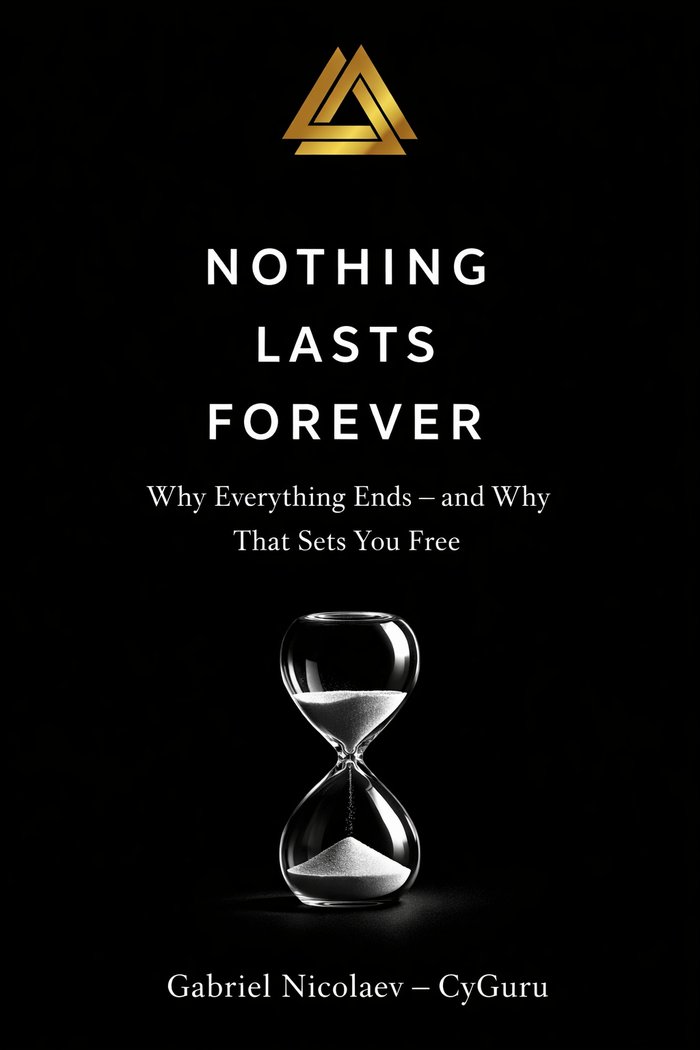
Nothing Lasts Forever
Impermanence can be understood intellectually long before it is accepted in a particular part of life. This title invites reflection on attachment, endings and the way a changing circumstance can expose an expectation of permanence.
View & order on CYGURU.com ↗