
Your Family Health History Is Information, Not a Verdict
Collect useful family health information, preserve privacy and discuss risk with a clinician without turning inheritance into certainty.

IN THIS ARTICLE
The family sentence that begins to sound like a predictionA family pattern contains more than one possible explanationGather a few useful facts instead of collecting alarming storiesAsk with respect for the person behind the informationAn incomplete history is a starting point, not a personal failureLet a clinician interpret risk and screening in contextA daughter separates resemblance from the next decisionCarry the history as knowledge rather than an identityThe family sentence that begins to sound like a prediction
Someone says that everybody on your father's side eventually gets the same illness. You hear more than a family observation. The sentence starts to organize your expectations about your own future. In the CyGuru interpretation, this is a moment to distinguish information from the meaning you attach to it. Family health history can be clinically useful. It does not become more useful when a general statement is treated as a personal diagnosis. Nor should the nervous-system doctrine be used to argue that interpretation can erase inherited risk. The responsible question is what is actually known, what remains uncertain and which qualified conversation can turn the information into an appropriate next step. Neither fatalism nor forced optimism supplies that assessment.
A family pattern contains more than one possible explanation
NIH MedlinePlus Genetics explains that relatives can share genes, environments and aspects of daily life; a condition in the family does not mean you will definitely develop it. This is general health information, not an estimate of your personal probability. Families may also use imprecise names for different conditions, so an apparent pattern deserves clarification before you build a detailed theory around it. Do not decide on your own that a pattern is entirely genetic, entirely behavioral or entirely a response to stress. Those explanations require different kinds of evidence. A Human Codes approach is most useful here when it improves the quality of the question, rather than supplying a universal answer before the relevant medical details are available.
Gather a few useful facts instead of collecting alarming stories
CDC guidance recommends recording conditions among close blood relatives and the ages at which they were diagnosed, then sharing what you know with your healthcare provider. Information from both sides of the family can matter. You can begin with a simple record: the relative, the reported diagnosis, approximate age and whether the information has been confirmed. Mark uncertainty honestly. A family recollection is worth bringing to the conversation without being presented as a verified medical record. Avoid asking every person you know whether their family experience resembles yours. The aim is a usable account of your own history, not an expanding collection of frightening examples that cannot establish what is likely to happen to you.
Ask with respect for the person behind the information
A relative's diagnosis belongs to a life that includes privacy, grief and possibly experiences they do not wish to discuss. Explain why you are asking and allow them to decline. You might say that you are updating information for a health appointment and would appreciate whatever they are comfortable sharing. Do not turn a family gathering into an interrogation. If someone gives you details, clarify how they may be stored or shared rather than assuming permission to post them in a large group chat. These are ethical recommendations for conversation, not medical requirements. Respecting privacy can coexist with taking health seriously. Your need for a complete story does not create unlimited access to another person's records or memories.
An incomplete history is a starting point, not a personal failure
Some people are adopted, estranged, displaced or unable to ask relatives who have died. Others receive conflicting accounts or discover that a diagnosis was never clearly understood. Do not invent certainty to fill those gaps. CDC advises sharing the information you do know with your healthcare provider, even when it is incomplete. In the clinical discussion, explain what is missing so it can be considered appropriately. The emotional question is separate: you may feel excluded from a form of knowledge other people take for granted. That deserves care without becoming evidence that your future cannot be managed. A missing chapter in the family record is a limit on available information, not a verdict on your ability to seek appropriate healthcare.
Let a clinician interpret risk and screening in context
Family history can help a healthcare provider consider which screening approaches or further assessment may be appropriate. The decision depends on the condition, the relatives affected and your individual circumstances. Do not copy a relative's screening schedule, start a supplement or arrange a genetic test solely because an essay made the family pattern feel significant. Bring the relevant facts and ask what they change, if anything, about your care. If genetic counseling or testing is being considered, ask what question it would answer and what its limitations are. This article does not supply a testing plan. The useful act of agency is participating in a qualified conversation with enough information to understand the reasoning behind the recommendation.
A daughter separates resemblance from the next decision
Imagine a woman whose mother developed a chronic condition. She notices that she sometimes feels tired and concludes she is following the same path. Her first step is not to debate whether she has inherited the same destiny. She describes her own symptoms to a clinician, explains the family history and asks what assessment is appropriate. Separately, she gathers a clearer account of her mother's diagnosis with permission. The example does not suggest what her symptoms mean or predict what the evaluation will find. It shows how two questions can remain distinct: what happened in the family, and what is happening now? Similarity in a family story should not replace assessment of the person currently seeking care.
Carry the history as knowledge rather than an identity
Keep the record somewhere appropriate and update it when meaningful new information becomes available. Use clinical guidance for decisions about your health, and do not treat recommended everyday habits as a guarantee against illness. A person who becomes ill has not thereby failed to think positively, regulate correctly or care enough. In the Nicolaev Medicine reading offered here, the value of a framework is its ability to keep the whole person visible while respecting the limits of interpretation. Your family history deserves a place in that account. It does not need to occupy every page. You can acknowledge an inherited uncertainty while continuing to make decisions about your present life with evidence, support and a realistic understanding of what remains yours to choose.
Continue the reading path
- The Nicolaev Medicine Manual: Which part of a health framework is an observation, an interpretation or a proposed intervention?
- THE FAMILY CODE: What does your family repeatedly teach through behavior rather than through words?
Sources and further reading
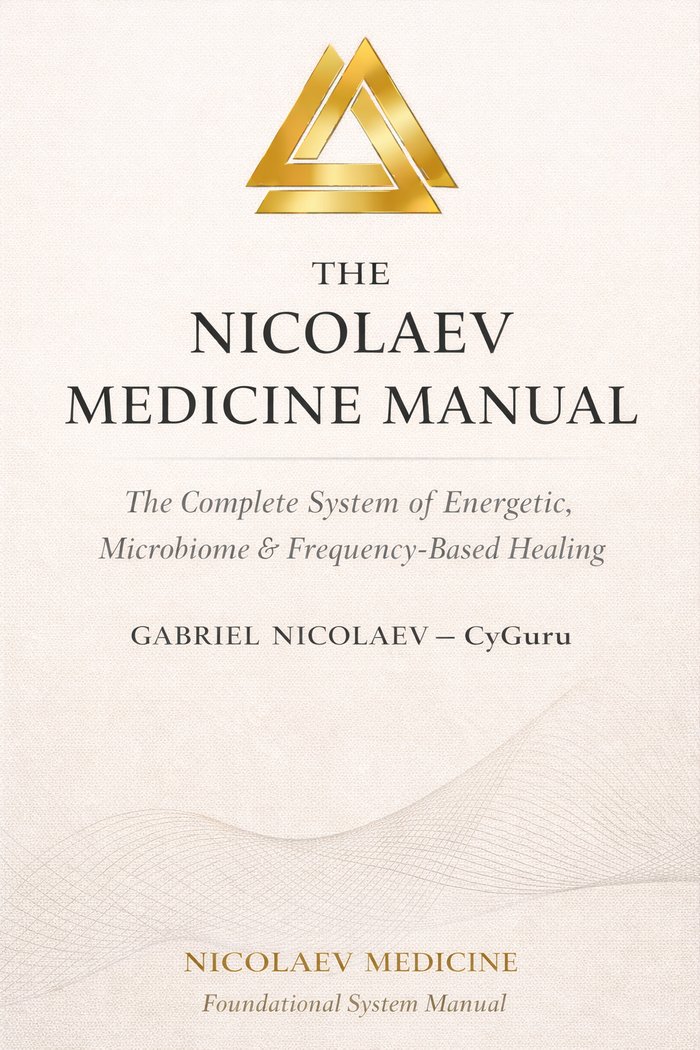
The Nicolaev Medicine Manual
A named health philosophy deserves to be examined on its own terms and against reliable evidence. This manual is the natural entry point for readers seeking to understand what the author means by Nicolaev Medicine.
View & order on CYGURU.com ↗